India Weather Update: Heavy Rainfall in South India, Fresh Western Disturbance to Bring Rain and Snow in North India

प्रकाशित:
India Weather Update: Heavy Rainfall in South India, Fresh Western Disturbance to Bring Rain and Snow in North India
India Weather Forecast | November 7, 2026
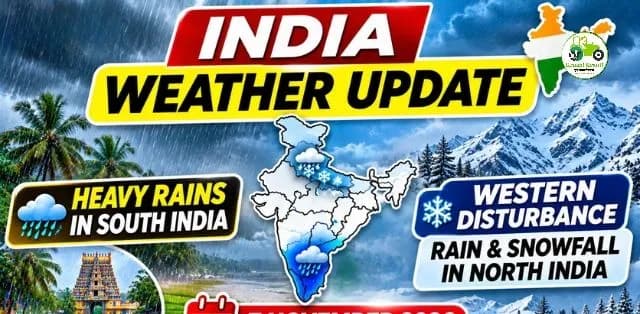
India is witnessing changing weather conditions as November progresses. While several southern states are experiencing heavy rainfall and thunderstorms, northern India is preparing for the arrival of a fresh Western Disturbance. According to the latest weather information provided by the India Meteorological Department (IMD), different parts of the country are likely to experience contrasting weather conditions over the coming days.
The southern peninsula continues to receive rainfall, while the Himalayan region may experience rain and snowfall around mid-November. Here is a detailed overview of the weather situation across India.
1. Heavy Rainfall Continues Across South India
Southern India remains one of the most active weather regions. Cyclonic circulations in the lower tropospheric levels and easterly troughs over the Arabian Sea and Bay of Bengal are contributing to rainfall activity.
Tamil Nadu, Puducherry and Karaikal are likely to experience significant rainfall accompanied by thunderstorms and gusty winds. Kerala and Mahe may also receive widespread showers during this period.
Some coastal areas could experience rough sea conditions and strong winds. Fishermen and people living in coastal regions are advised to follow local weather warnings and avoid venturing into the sea whenever official advisories restrict fishing activities.
Heavy rainfall may also cause temporary waterlogging in low-lying areas and affect road transportation.
2. Fresh Western Disturbance Approaching North India
While southern India is experiencing active rainfall, a fresh Western Disturbance is approaching the northwestern Himalayan region.
According to the weather outlook, the system may begin influencing the region around November 10. Jammu and Kashmir, Ladakh, Gilgit-Baltistan, Muzaffarabad and Himachal Pradesh may experience isolated to scattered rainfall.
Higher-altitude areas could also receive snowfall by mid-November. The changing weather may lead to colder conditions in mountainous regions.
Travellers visiting hill stations and mountain routes should monitor weather forecasts and local administration advisories before travelling.
3. Weather Conditions in Delhi, Punjab and Haryana
The plains of northern India, including Delhi-NCR, Punjab and Haryana, are currently experiencing largely dry weather.
Skies are expected to remain mostly clear, although shallow fog or mist may develop in some places during the early morning hours.
Minimum temperatures are above normal in several locations, while daytime temperatures remain relatively comfortable. The approaching Western Disturbance may bring changes in atmospheric moisture and gradually influence night temperatures.
4. Rainfall Activity in East and Northeast India
Weather activity is also expected across eastern and northeastern parts of the country.
The Andaman and Nicobar Islands may continue to receive fairly widespread rainfall. Meanwhile, Assam, Meghalaya, Nagaland, Manipur, Mizoram and Tripura may experience isolated to scattered showers.
Some northeastern locations could receive heavy rainfall as moisture-laden winds interact with the region's geographical features.
Residents in vulnerable areas should remain alert to local weather warnings, particularly where heavy rainfall may affect roads and low-lying settlements.
5. Impact of Changing Weather on Agriculture
Changing weather conditions can influence agricultural activities in different regions.
Farmers in southern states should take precautions against waterlogging and strong winds. Standing crops, banana plantations, papaya orchards and vegetable fields may require additional support and proper drainage arrangements.
Farmers in northern regions should monitor temperature changes and plan irrigation and field activities according to local weather conditions.
Some important precautions include:
Remove excess water from fields after heavy rainfall.
Provide support to vulnerable crops and young plants.
Protect harvested produce from unexpected rain.
Avoid unnecessary spraying during thunderstorms or strong winds.
Follow local agricultural department recommendations.
India is entering a transitional weather phase during November 2026. Southern states are likely to continue experiencing rainfall and thunderstorms, while a fresh Western Disturbance may bring rain and snowfall to parts of the Himalayan region around mid-November.
Delhi, Punjab and Haryana are expected to remain largely dry for now, while eastern and northeastern regions may experience scattered rainfall.
Citizens, farmers and travellers should regularly monitor official weather updates and district-level alerts